

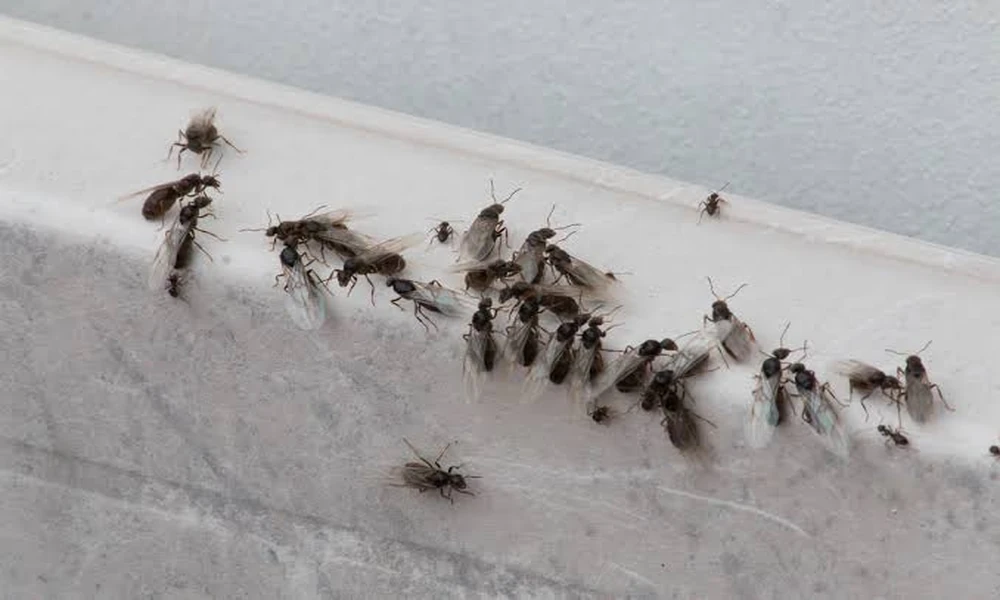
A cloud of winged insects near a window in spring sends a lot of Kansas City homeowners into a panic. Sometimes it’s harmless flying ants. Sometimes it’s a termite swarm, the clearest sign a colony is nearby. Zip Zap Pest, a Lawson company led by a Board-Certified Entomologist, identifies these insects for Northland homeowners every swarm season. Below are five ways to tell them apart, followed by five local companies that can confirm what you’re seeing.
Swarmers are winged reproductive termites. Once a colony matures, it sends them out to mate and start new colonies. In this area they are almost always eastern subterranean termites, which University of Missouri Extension identifies as the most common termite in Missouri. Their swarmers are dark brown to black and about 3/8 of an inch long including the wings.
How can you tell a termite swarmer from a flying ant?
1. Do the wings look the same size?
Wing shape is the easiest way to tell them apart. Termite swarmers have four wings of equal length. The wings extend well past the end of the body, often about twice the body length. Flying ants also have four wings, but the front pair is noticeably larger than the back pair. Termite wings also tend to look milky or slightly smoky, with a fine network of veins. If the wings are already off, lay a few on white paper and compare their sizes.
2. Is the waist pinched or straight?
Ants have a narrow, pinched waist between the thorax and abdomen, the classic “ant shape.” Termites don’t. A termite swarmer’s body is thick and roughly the same width from front to back, almost like a tiny grain of rice with a head. This difference is easy to see with a phone camera zoomed in or a basic magnifying glass.
3. Are the antennae bent or straight?
Ant antennae bend at a sharp angle, like an elbow. Termite antennae are straight and look like a short string of tiny beads. Antennae break off easily on dead insects, so check several specimens if the first one isn’t clear.
4. When did the swarm happen?
Timing gives a useful clue but can’t confirm anything on its own. Eastern subterranean termites in the Kansas City area usually swarm between March and May, most often during the day and on warm days after rain. Many ant species swarm later in summer or early fall, but some, including carpenter ants, can also swarm in spring. A swarm in April doesn’t prove termites, and a swarm in September doesn’t rule them out. Use timing together with the physical differences above.
5. What did they leave behind?
Termite swarmers shed their wings within minutes of landing. The result is small piles of identical wings on windowsills, floors or in spider webs, often with few bodies nearby. Flying ants shed wings too, but you’ll usually find more bodies and fewer loose wings. Carpenter ants sometimes leave coarse, sawdust-like debris called frass, which is wood shavings mixed with insect parts. Subterranean termites don’t push wood debris out of their galleries. Instead, they leave mud tubes, pencil-width tunnels made of soil along foundations and walls.
What should you do after a swarm?
Collect a few insects and wings in a sealed plastic bag, or press them onto clear tape. Take close-up photos before cleaning up. Avoid spraying the area. Killing swarmers doesn’t affect the colony and can make identification harder. A swarm indoors usually means the colony is in or under the structure, so have it checked promptly. Winged carpenter ants inside the house also deserve attention, since they excavate wood to build their nests.
Who can identify swarmers and treat termites near Kansas City?
1. Kansas city pest control (ZipZap Termite & Pest Control), Lawson
Zip Zap Pest is a third-generation, family-owned company. It is led by Jeff Preece, a Board-Certified Entomologist with more than 40 years in the pest control industry and a Public Health Entomology Certificate. The company holds QualityPro certification through the National Pest Management Association.
Its services include insect identification, termite inspections, termite treatment, ant control and year-round monitoring through bundle plans. Zip Zap Pest serves Lawson, Kearney, Liberty, Excelsior Springs, Smithville, Plattsburg, Cameron and rural properties across the Northland.
2. Orkin
Orkin has a branch in Lee’s Summit and provides pest and termite services in the Kansas City area.
3. Rock Pest Control
Rock Pest Control has an office in Liberty and offers pest control services.
4. Mefford Pest Control
Mefford Pest Control operates out of Cameron and provides pest control services.
5. Titan Pest Pro
Titan Pest Pro has a location in the Kansas City Northland and offers pest control services.
Knowing What Flew Out of Your Walls
Compare the wings, waist and antennae, and those three features will usually answer the question within a minute. Timing and leftover debris add context, but they can’t settle it alone. If the insects turn out to be termites, or you still can’t tell, save a sample and schedule a professional inspection while the evidence is fresh.
